
Google Calendar sync
Connect your personal Google account so CaseFlow events stay in step with your Google Calendar in both directions. Hearings, depositions, and meetings you create in either system land in the other automatically. Sync is per-staff (each member connects their own account), not per-firm.
Plan requirement
Google Calendar sync is available on the Growth plan and the Multi-Practice plan. The 14-day trial includes it.
How sync works
- Bidirectional. Events created or edited in CaseFlow are pushed to Google. Events created or edited in Google are pulled into CaseFlow.
- Cron-driven. Sync runs every few minutes in the background. There is no live push the moment you save an event; expect a short delay.
- Per-staff. Each staff member connects their own Google account. CaseFlow only syncs to that user's primary Google calendar; secondary calendars under the same account are ignored.
- Future-only by default. When you connect for the first time, only events from today forward sync. Past events stay in Google unless you explicitly import them (see below).
- Confidentiality preserved. Events linked to a matter, or assigned to a protected category (Court Date, Hearing, Deposition, Filing Deadline, Statute of Limitations), are pushed to Google with visibility = private and the description stripped. Anyone with calendar share access on your Google account sees only "Busy" instead of privileged detail.
Connecting your account
Open your profile (click your name in the top-right corner of the page, then My Profile) and scroll down then click the Calendar Sync card. You can also reach the page from the Open sync settings button on a calendar warning banner.
Click Connect Google Calendar. You will be redirected to Google to grant CaseFlow access to your calendar. CaseFlow requests the least-privilege Google scope: permission to read, create, edit, and delete events. CaseFlow does not enumerate or read other calendars on your account. Approve, and Google sends you back to CaseFlow.
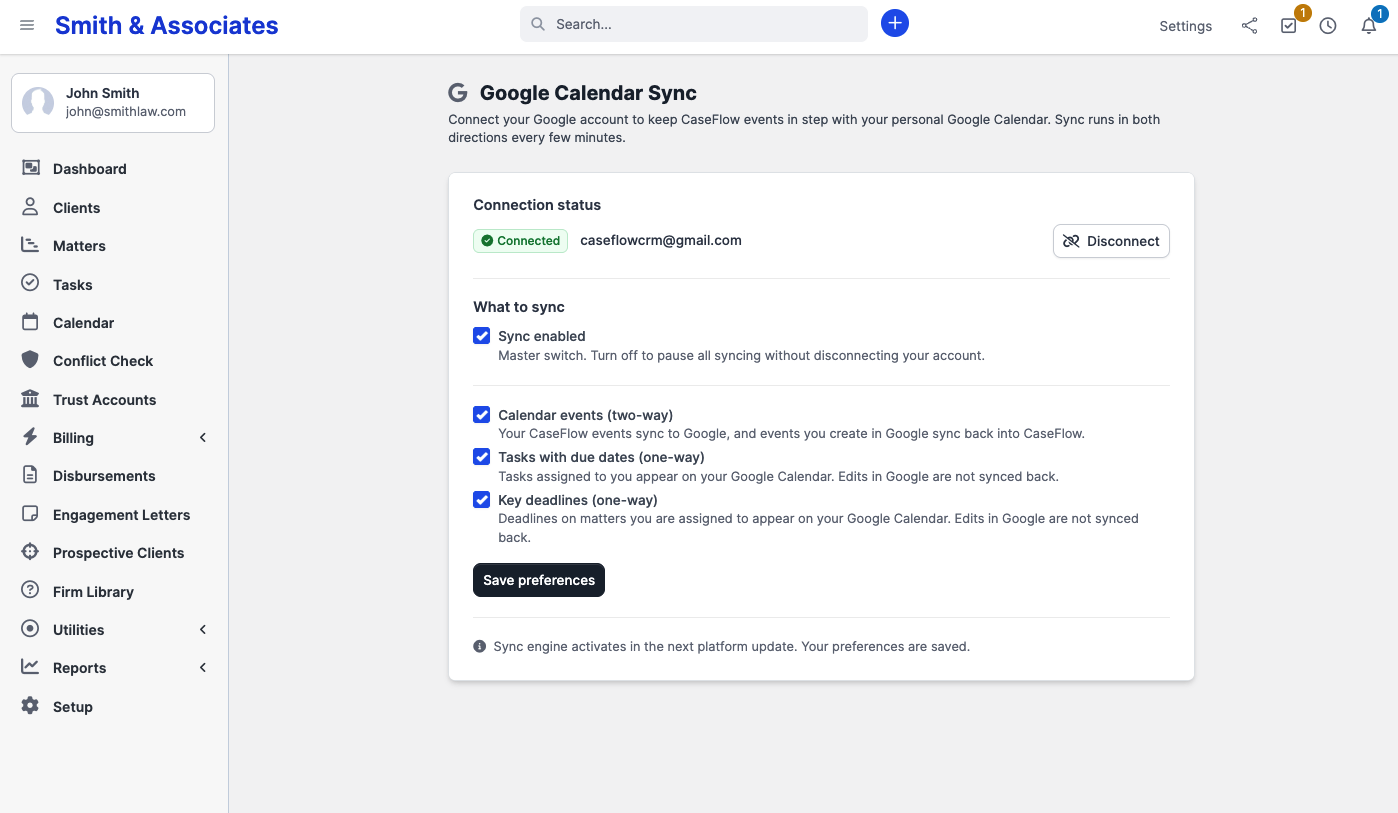
Once connected, the page shows your Google email with a green Connected label and a Disconnect button.
What syncs
Below the connection status, a What to sync form lets you fine-tune what flows between CaseFlow and Google. There are four toggles:
| Toggle | Direction | Description |
|---|---|---|
| Sync enabled | (master switch) | Turn off to pause all syncing without disconnecting your account. Useful before a long vacation or a sensitive matter window. |
| Calendar events (two-way) | both ways | Your CaseFlow events sync to Google. Events you create in Google sync back into CaseFlow. |
| Tasks with due dates (one-way) | CaseFlow to Google | Tasks assigned to you with a due date appear on your Google Calendar. Edits you make to those tasks in Google are not synced back. |
| Key deadlines (one-way) | CaseFlow to Google | Deadlines on matters you are assigned to appear on your Google Calendar. Edits you make to those deadlines in Google are not synced back. |
Click Save preferences to apply.
Importing past events
When you first connect, only future events sync. To pull older events from Google into CaseFlow, click one of the import buttons:
- Import last 30 days
- Import last 90 days
Both actions are idempotent. Running an import twice does not duplicate events; previously-imported items are skipped.
The 90-day cap is a hard limit. If you need older events than that, contact support.
Imported events are stamped in the event audit log so a later admin can tell them apart from organic syncs.
Manual sync
You can pull the latest changes from Google without waiting for the next scheduled sync. Click Sync now at the top of the settings page. CaseFlow fetches fresh changes from Google immediately. Any CaseFlow-side events you created or edited since the last sync still go out on the next regular run, not in this manual pull.
If something has gone wrong, an error banner appears with the underlying message. Click Retry now in the banner; transient errors usually clear on the second attempt.
Disconnecting
Click Disconnect on the settings page to revoke CaseFlow's access to your Google account. Sync stops immediately. The events that have already synced stay where they are; no records are deleted in either system.
If you disconnect and then later want to reconnect, click Connect Google Calendar again. You may need to first remove CaseFlow from your Google account permissions if Google still has stored consent, otherwise the reconnect can fail without issuing a fresh refresh token.
Privacy in detail
CaseFlow follows ABA Model Rule 1.6 by default: information related to the representation of a client is presumed confidential. The sync engine acts on that presumption automatically.
When CaseFlow pushes an event to Google, it strips the description and sets visibility to private if either of these is true:
- The event is linked to a matter (any matter, any client)
- The event uses a protected category (Court Date, Hearing, Deposition, Filing Deadline, or Statute of Limitations by default; firms can edit the list in event categories settings)
The event title and start/end times still go through, because that is what makes the event useful as a calendar entry. But the body text is replaced with "Private" before it leaves CaseFlow. Other staff members or family members who can see your Google calendar will see the appointment exists but cannot read what it is about.
For the reverse direction (Google pull into CaseFlow), CaseFlow respects sync conflicts on protected-category events. If you edit a Court Date event in both Google and CaseFlow within the same sync window, the conflict is logged and surfaces on the calendar page rather than silently overwriting either side.
Plan availability
Plan requirement
Google Calendar sync is available on the Growth plan and the Multi-Practice plan, including the 14-day trial.
Next steps
- Outlook sync - The Microsoft equivalent on the Multi-Practice plan
- Creating events - The CaseFlow side of what gets synced
- Calendar overview - Sync banners and global calendar settings